Delivered at the ‘Psychoanalysis, Culture and Society’ conference at the Centre for Psychoanalysis, Middlesex University
In ‘Civilisation and its Discontents,’ Freud describes the home as being like the womb[1], and in architecture this function found its place in the necessity to protect human beings from the elements. One might assume, from a position that advances the beginning of comfort as a spatial phenomenon, that architecture is the inactive background to everyday life, and whose primary role is to shelter. It certainly does have the capacity to perform exactly these functions, but where the home may be seen to be the inactive setting for the scene of the family through the relationships of spaces that contain the very basics of familial life although the manner that it appears will alter from culture to culture – it has the capacity to provide a frame for how we view familial life and how we are supposed to experience it. To some end, it is true that the home contains, to use containment in Bions concept of containment[2], and it provides protection from the forces of the world out there. But spatial experience in architecture implies that there is a direct implication on the body, senses, and mind, giving an active presence to the architectural object in its relationship with the subject that is constructed through how we see the object and how we are being seen by it.
With Renaissance architecture, the advent of perspective, and even later in Modernism, we witness the relationship between the subject and the architectural object occurring axially – through the medium of the body – where the architecture sought to locate the human body within its structure through proportions found inherent in nature and the origins of perspective through developments in science. When Le Corbusier went to Athens and studied the Parthenon, he wrote that he found himself confronted with the reality of his own subjectivity and developed a formula to replicate this direct relationship to the body within his designs. Architecture is the pure creation of the mind, it is a “plastic art,”[3] he said, and it “must be clearly formulated”, it is measured with the eye and is experienced with the senses of the body. One might be able to gain a clear initial understanding of the plastic arts through Le Corbusier’s definition of the regulating line, which is what produces the perception of order in the proportions of ones “natural understanding” of what is known as the golden section, a system of measurement for proportions inherent in nature, which we “sense [to be] harmonious.” According to observations on the primitive hut, made by the Roman architect
Vitruvius’, man made a choice for a shelter that resonated most closely with the scale of his own body. When creating the shape of the enclosure, apparently he instinctively went for ‘geometric truths’ that essentially are effects that our eye measures and recognises. According to Le Corbusier, in his book Towards an Architecture, these choices were made so that man could begin to regularise and order the arbitrary, disordered, world around him. One of Le Corbusier’s most well-known architectural observations of such endeavours to regularise the world, through the effects of visual harmony, were those that he made during that visit to the Parthenon in Athens. He believed that with the sight of harmony of the elements the axis of the human body was touched[4], and thus one would experience an inner resonance with the sense of sight through this regulating line. Architecture, in this way, can be seen to confront the subject with the mirror of a constructed view of its own sense of subjectivity, with a mirror of the subjects understanding of the physical self. But this was not an individualised sense of self, which is related to a differentiated internalised experience that connects to ones mental life, but rather an inherent one that is related directly to proportions and axes of the human body. Anyone who went to the Parthenon might, in theory, have had the same experience – you might still have the same experience. This is what some art historians at the time referred to as ‘empathy’, where the spatialisation of empathy was based on the idea that the human figure gave directionality to all of an enclosure, in relation to both the x and y axes. Thus, empathy linked the aesthetic manifestation of the object to what was called ‘the bodily substrate of the mental life.’[5] This marked the beginnings of a theory of a way into the mental life of the subject that was to occur through the sensory experience of the body within space. In a way, architecture and the architecture of the home, endeavoured to remain neutral, to be the container for the contained in Bions terms, without affecting the occupants in any way other than to promote the feeling of comfort and not much more. Space was a porous receptacle for psychic projection in which feelings were not contained but from which any anxieties the subject might have had, which could potentially be provoked by a space, could escape. In early 20th Century Modernism with the discovery of Psychoanalysis we begin to see a desire to merge the human body with the object and this in turn had begun to reveal a desire not to be overwhelmed by space. The idea of projecting the subject into space produced ideas of anxiety and spatial phobias that were to be avoided, and the way to avoid it was to continually activate the presence of human proportion within the structure. To induce a sense of comfort it was important to enable the subject to recognise their physical self and provide them with the spatial means to carry out the functions of their everyday life within the space. So space, up until this point, was to contain but was to remain a passive reflection of human proportion and habit but was unable to directly access the mental substrate.
Space could be considered to be a porous receptacle for psychic projection in which feelings were not properly contained but from which anxieties could escape. With an era that was exiting the Romanticist period along with its fixation on the sublime, there was the view that the space of the world did not necessarily produce sensations of pleasure but rather threatened to overwhelm, consume and absorb. In other words, we would become aware of the space when we were forced to empathise with it, and this awareness would occur when the space began to promote feelings of discomfort. If it failed to discomfort then we would remain relatively unaware of it – it would passively act like a backdrop. It is through the discomfort manifested through a particular type of space that we become aware of ourselves and the cathexis that occurs. This empathising of Riegl[6] might relate to what was later referred to as the gaze, the term coined by Lacan[7] to describe the state of awareness that one is also an object that can be viewed. It is with the gaze that one loses a degree of their autonomy over the object. At this point, Le Corbusier, confronted with the Parthenon, realised himself to be an object. He was a figure of a certain proportion with bilateral symmetry, a feature we all share, and he could see himself in the proportions and symmetry of the Parthenon. They shared some sense of identification with one another as one could be perceived to be mirrored within the other, this was the gaze but this was not empathy. If we take Architecture to be an attempt to articulate subjective structure and to mediate the relationship between the subject and the object then we might begin to ask what sort of space do is it that we are occupying. Space is soothing when it does not ask us questions about our presence or our behaviour but rather acts as a receptacle for containing or sheltering all of our phobias and anxieties, and a typical house will be soothing when it does not encroach upon us. The normative effect of visual sensations and the axial relationships that the body has to the edifice brings about a reconciliation between the subject and the object. It is with this mediation that the relationship between the subject and the object is brought together. For Le Corbusier, Architecture is a plastic creation of the mind[8], and for him plasticity is what we see and what we measure with our eyes[9]. Proportion is a visual effect on the axial relationship to the body, and one will always have a sensory response to any observed object. Proportional similarity, and the form of the object, according to Vischer, is what produces the harmony or the communication between the object and the subject[10].
In ‘House VI’, designed by Peter Eisenman for Mr and Mrs Frank in 1975, purposely disregards any notion for function, and any notion for axial relationships. He sought to make the users continuously conscious of how they use the house, where columns and beams often play no role other than to disorientate and break up the familial agenda of being together.[11] A column in the kitchen hovers over the kitchen floor and doesn’t touch the ground, another beam hovers over the dining room table almost separating those dining. Beams meet but do not intersect, and the spaces are unconventional for living, where in the main bedroom there is a glass slot directly in the centre of the wall that continues through the floor and divides the room in half. This made separate beds the only possible option for this married couple. The house confronts them with a certain antagonism that makes them aware of their misaligned presence in the space, the axial relationships that we have spoken of are dislocated and irregular. It is a holding environment used to provoke and hold the inhabitant’s anxieties without attempting to dispel them – the opposite of reverie and comfort.
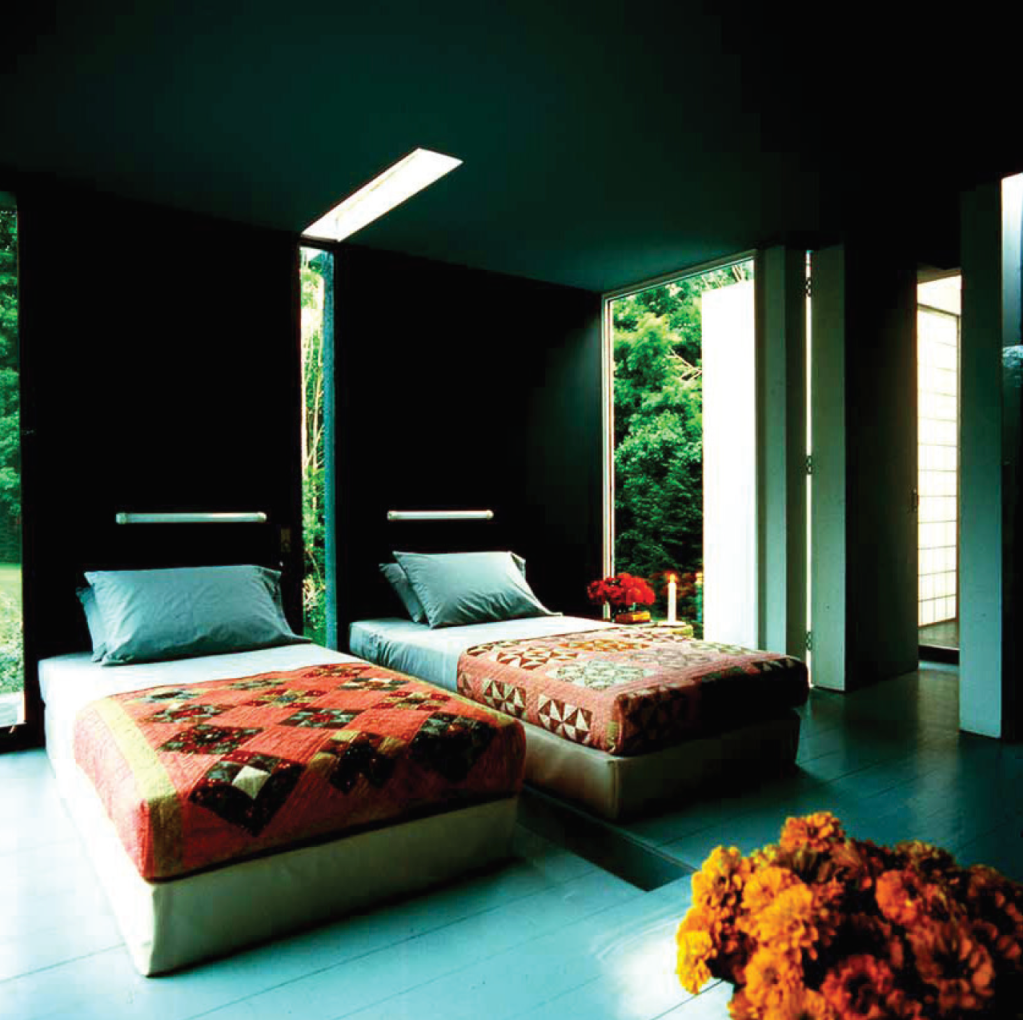
Bedroom of Mr and Mrs Frank in House VI. (image from eisenmanarchitects.com)
The bi-lateral communication, proportional and symmetrical mirroring, which we have explored earlier, has been upended in House VI, we are no longer lulled into a recognition of ourselves within a mirroring object but are forced to see the object through invoked discomfort, one which we are unable to master but that might be able to master us. According to Laplanche and Pontalis this is the definition of anxiety, a theme which is at the root of psychoanalytic explorations into the human condition. Laplanche and Pontalis describe anxiety as being “the subject’s reaction each time he finds himself in a traumatic situation – that is each time he is confronted by an inflow of excitations, whether of external or internal origin, which he is unable to master.”[12]
With the discovery of psychoanalysis in the late 19th Century, themes such as the uncanny[13], and spatial estrangement[14][15] were linked to the aesthetics of space. There was a preoccupation in Modernism that space was founded on the understanding that the relationship between a subject and an object was based on a shifting point of view, which was determined wholly by a body moving in space, and it was in this way that the mental substrate would be affected. Spatial dimensions became a preoccupation for the architects of the period, such as Le Corbusier, who were trying to understand and spatially articulate the subject/object relationship. In Modernism the body begins to become a sort of measuring device for spatial experience, mediating that which is perceived through the bodies position in space and through its senses as a means to gain access to the mind. But if the houses of Modernism were containers that reflected the subject, with Deconstructivism and House X by Peter Eisenman, we can see that it becomes possible to begin to read a burgeoning provocation of certain states of being in the subject, which occur through an architectural object that was now designed to be deliberately active. House VI has the capacity to disorientate, confuse, or bring about other unpleasant emotions. It alerts the mental substrate via the experience of the body that it is no longer being empathised with by the architecture of the home, and is no longer simply a passive container whose primary aim is to shield the subject as it now tries to affect the inhabitant.
[1] S. Freud, Civilization and Its Discontents, trans. J. Strachey (New York: W.W. Norton & Company, 1961), p. 59.
[2] W.R. Bion, ‘Attacks on Linking’, International Journal of Psycho-Analysis, 40.5-6 (1959), pp. 308-315.
[3] Le Corbusier, Towards a New Architecture, trans. F. Etchells (New York: Dover Publications, 1986), p. 1.
[4] Ibid., pp. 67-78.
[5] W. Wundt, Principles of Physiological Psychology, trans. E.B. Titchener (New York: Macmillan, 1904), p. 1.
[6] A. Riegl, ‘The Modern Cult of Monuments: Its Character and Its Origin’, trans. K.W. Forster and D. Ghirardo, Oppositions, 25 (1982), pp. 21-51.
[7] J. Lacan, The Four Fundamental Concepts of Psychoanalysis: The Seminar of Jacques Lacan Book XI, ed. J.A. Miller, trans. A. Sheridan (New York: W.W. Norton & Company, 1998), p. 67.
[8] Le Corbusier, Towards a New Architecture, trans. F. Etchells (New York: Dover Publications, 1986), p. 1.
[9] Ibid., pp. 243-244.
[10] R. Vischer, ‘On the Optical Sense of Form: A Contribution to Aesthetics’, in Empathy, Form, and Space: Problems in German Aesthetics, 1873-1893, trans. H.F. Mallgrave and E. Ikonomou (Santa Monica: Getty Center for the History of Art and the Humanities, 1994), pp. 89-123.
[11] S. Frank, Peter Eisenman’s House VI: The Client’s Response (New York: Watson-Guptill Publications, 1994).
[12] J. Laplanche and J.B. Pontalis, The Language of Psychoanalysis, trans. D. Nicholson-Smith (London: Karnac Books, 1988), p. 37.
[13] S. Freud, ‘The “Uncanny”‘, in The Standard Edition of the Complete Psychological Works of Sigmund Freud, Volume XVII (1917-1919): An Infantile Neurosis and Other Works (London: Hogarth Press, 1955), pp. 217-256.
[14] G. Simmel, ‘The Stranger’, in The Sociology of Georg Simmel, trans. K. Wolff (New York: Free Press, 1950), pp. 402-408.
 DENA ZIARI