Written for Estudio Tupi and INHOTIM, Belo Horizonte, Brazil, in May 2012.
“Wherfore not Utopie, but rather rightely my name is Eutopie, a place of felicitie.”
— Sir Thomas More, ‘Utopia’ (i)
“The function of myth is to allow both views to be held in some kind of para-logical suspension.”
— Rosalind Krauss, ‘Grids’ (ii)
“The mirror acts as a metaphor for a love affair of such intensity … ‘Without a yesterday, without a tomorrow. This pure face starts anew. The most important day of my life, forever’.”
— Paul Éluard (iii)
The mirror, reflecting the present, allows narrative to unravel as randomly and unpredictably, as a passing cloud over a vast, lush, and undefined landscape, weaving it into the story of a wondrous mythology of the here and now.
She stood, under the shade of the story of concrete, somewhere in amongst the crumbled ruins of the walls of a garden. She is the appearance of a complete creature who resides in a land that one could be forgiven for mistaking as Arcadia, and here she stands, poised before a mirror carefully studying the changing reflection of her self.
She is the mythology of the past and the future, the mythology of the movement of material. She is solid and yet mobile, substantial and static, she is wholly and emphatically capable of transformation (iv). She is the breathing, living, Present that is desirous of Tomorrow. She is the Tomorrow that is always arriving, which was a Yesterday that has long since gone. She is her own saudade. If you call out to her she may answer to the name Astraea, and perhaps she was even enlisted to preside over this landscape, where the slowly breathing dualities of the past and future of her self in their slumbering, temporal, simultaneity surround her like a misty shroud, covering her entire body, though never engaging her skin. This is the moment of a precise distinction between her realism and her imagination, one part future, one part past, projected into the many frames of time, and she is held in suspension within its entirety (v).
She is the breathing present. She is the mirror.
Utopia is a no place, it is a good place; it is both. The term utopia, which correctly refers to ‘no place’, cannot be properly referred to without mentioning its opposite, the English homophone, Eutopia that means ‘good place’. Being a homophone, it creates a phonological confusion when attempts to describe an idealised, perfect, place, are made because one would simultaneously imagine that this place is in fact no place at all. Historical notions of Utopia speak of a place that is outside of the bounds of history, or a place that is positioned in a time that is either in the past or in the future – a Golden Age, where things were, could be, or are, in fact, better than here. This place is anywhere but here, and it is bound by anachronistic notions of the past. When referring to notions related to Utopia, or Paradise, one is unintentionally positioned at a point where the tensions emerging from the dualities of the E-utopian homophone appear to join, giving rise to the formation of a mythological archetype that serves to assist us in the onerous understanding of these merging opposites. The formation of mythologies help us to deal with things that appear to sit outside of the comfortable realm of what would usually be considered to be realism. Utopia is a term often used in order to refer to an ideal place, past, and future, and it specifically refers to the relationship that all three periods have to one another. The notion was largely inspired in the 16th century by literature based on the Portuguese and Spanish discoveries of the Americas (vi). These idealised places may be mythical ideas of the otherworldly, anywhere but here, or have their foundations in the literal annals of historical documentation (vii).
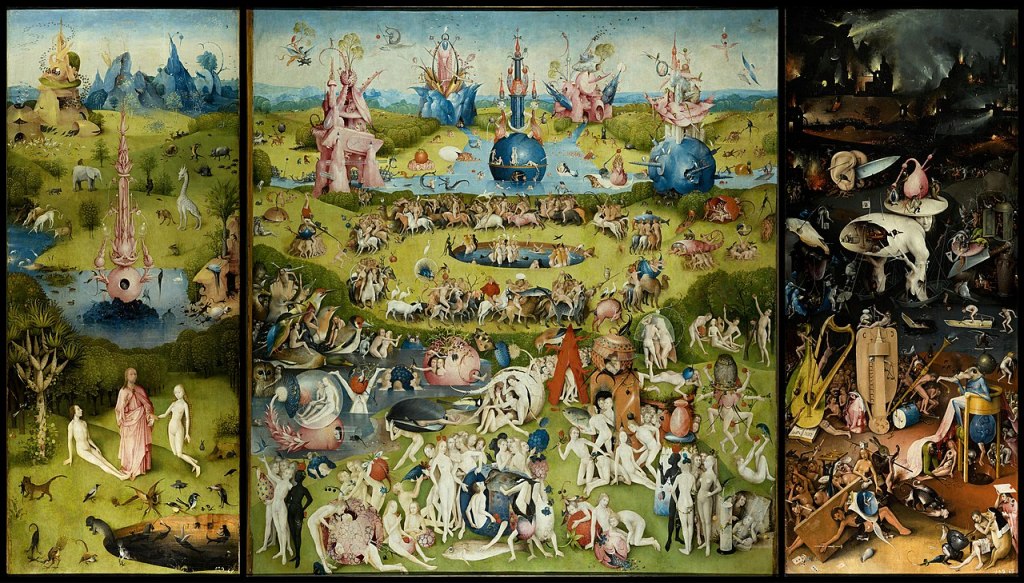
Fig 1. Hieronymous Bosch, ‘The Garden of Earthly Delights’ (circa. 1490-1510).
Utopia, as a concept, first imported into the English language from Greek by Sir Thomas More, relates most famously to the Christian religious ideas of the Garden of Eden as the original birthplace of humanity (viii). Adam and Eve were expelled from the Garden of Eden because they ate the forbidden fruit of the Tree of Knowledge of Good and Evil. Humanity is thus separated from this heavenly garden, and is destined to be denied re-entry [Fig 1.]. The Christian idea of Eden, in these terms, described in the Book of Genesis as the source of four tributaries, could be considered to be derived from the Persian concept of ‘paradise’ (ix) [Fig 2.]. Paradise, where ‘para-daiza’ in Old Persian meant ‘walled estate’ (x), is known to have been first used in the written inscriptions of the Avesta, the Zoroastrian holy-book. It was referred to as a terrestrial walled garden that was to contain all of the elements that were needed in order to sustain life (xi). The wall was not defensive, like a fort, but rather it insists on the idea that the wall is simply a divider of space as it defines what does and does not belong to the confines of this physically demarcated expanse. Paradise would have been a real place of recreation in the most precise and most profound sense, and it would have contained all
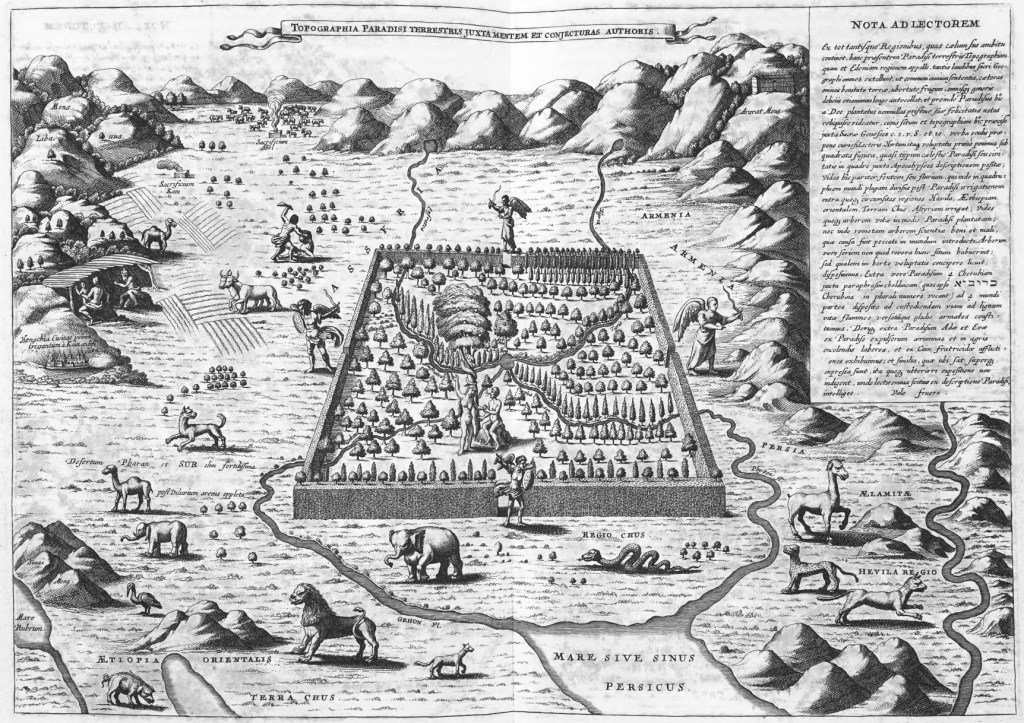
Fig 2. Athansius Kircher, ‘Topographia Paradisi Terrestris’ (or ‘Terrestrial Paradise’), 1675 (?)
of the elements that constitute the sustenance and the happiness of mankind according to the Zoroastrian ideals of “good thoughts, good actions, and good deeds”. It was in a garden, after all, that man first defined and modified his universe by asserting his vision over landscape (xii). Though Paradise seems to have an historical relationship to the beginnings of the polis (xiii), both Paradise and Utopia have since become mythological archetypes for the other-worldly, anywhere but here, idealistic assertions of man over terrain, and of places that perhaps exist outside of the temporal frame of the present. Thus, Paradise is either a walled-garden or it is a polis, and from within the confines of its original meaning it was a place that was indeed a here and now that has since been replaced by a place that is anywhere but here. A place of purity, harmony, and virtue goes hand in hand with the myths of the Golden Age of Hesiod. Having its roots in Greek mythology and Hesiods’ poetic work ‘Works and Days’ (109-126), he identifies five ages of man where each succeeding age was considerably worse than the one that existed before it (xiv). He maintains in his text that during the Golden Age “men lived like Gods without sorrow of heart, remote and free from toil and grief” (xv). The Golden Age was subsequently abandoned, according to Hesiod, when the Gods had the impulse to create an inferior Silver Age (xvi). The Golden Age exists, unlike Utopia – which has no specific allegiance to either the past or future – in a time that has long since gone. And like the longing nostalgia that exists for ones lost youth, the past state of perfection attained in the Golden Age would still be pined for. Literary works have played an important role in the depictions of these ages of perfection, these other-worldly places that are still pined for, where some stories are based on actual historical events – and are mythologised in the written word.
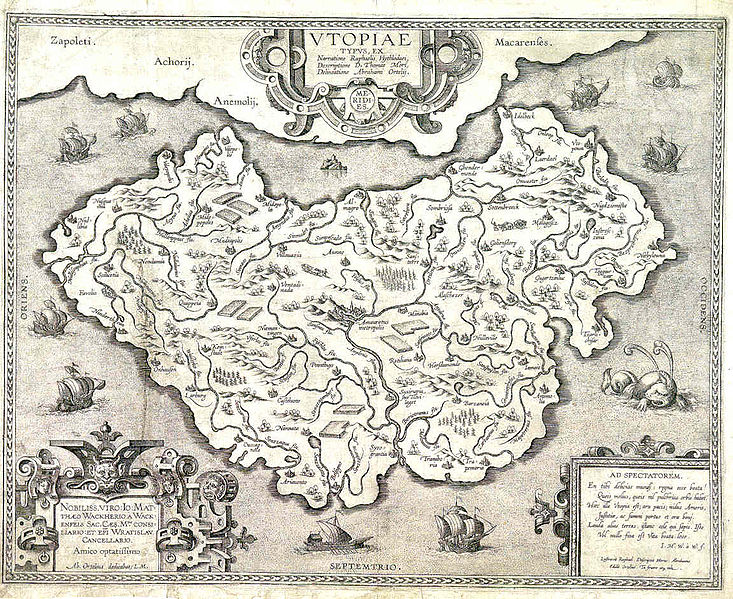
Fig 3. Map of Utopia, 1595, by the cartographer and geographer Abraham Ortelius.
In his book entitled ‘Utopia’, published in 1516, Sir Thomas More writes of a fictionalised island in the Atlantic Ocean [Fig 3.], a place he calls Utopia. To assist his vision of this fictionalised place, he used the real life accounts made by the navigator and explorer Amerigo Vespucci. More created a character named Raphael who is suggested in the text to be one of the men that was left at Cabo Frio, Brazil, for 6 months by Vespucci himself. After his time in Cabo Frio, the character Raphael travels on to discover the fictionalised island in the Atlantic Ocean – the island of Utopia. Intimately bound to Vespucci’s accounts of travels, More enthusiastically used the real accounts written by Vespucci where he had documented findings of communal properties amongst people, where there was ‘no trade, they neither buy nor sell’, where precious metals were held with no value, and each person was their ‘own master’. The Americas, so named after Amerigo, was believed by Michel de Montaigne to demonstrate the Golden Age with far more clarity than any depiction that followed that of Hesiod. To the imagination of the 1500’s, Thomas More and Michel de Montaigne, it was possible that this idealised no-where place had finally been discovered on Earth. Perhaps paradise was not somewhere else after all, its terrestrial twin had been discovered by man, and it was called the Americas.
In the poem by the 20th Century Brazilian poet and literary critic Manuel Bandeira entitled ‘I am Leaving for Pasargadae’, he writes with longing about going to a place that is free from the difficulties of his life,
“When during the night I am feeling sadder
Sad without hopeWishing to kill myself
– There I am the King’s friend – Have the woman that I want
In the bed that I choose
I am leaving for Pasargadae” (xviii)
Bandeira writes of the first time he came to hear about Pasargadae. It was when he was 16 years old, through a Greek author, and in his imagination it was a “wonderful landscape, a country full of delights.” He saw in his poem a picture of his whole life, with all of the promise of the dreams of his youth, he was projecting himself into the paradise of his yet untainted future. Pasargadae, for Bandeira, was where one could live in dreams “which our cruel life did not want to give us.”(xvii) The otherworldly idea that a better place exists somewhere that is not here is clearly present in this excerpt, and literature has been responsible for a lot of the succeeding visions of Paradise and Utopia that we have had since the first known depictions that piously appeared in the Avesta and Genesis (xix). Pre-20th Century literature on Utopia often refers to it as being an otherworldly place that is set in the past, in the future, or in another place entirely, transposing it to a mythology that is set outside of historical time in order to deal with the uncomfortable sense of its apparent unattainability. For Bandeira, too, Paradise is still somewhere else. It is possibly attainable. It is impossibly attainable.
Utopian ideals become mythical archetypes when they fall out of step with realism, and these archetypes rise to deal with this discrepancy as they are nowhere, in the distant past or future, and we need assistance in order to understand them fully. Lévi-Strauss, in his four volume study on mythology entitled Mythologiques, looks at the structure of myth and its formation. He states that human beings tend to think of the world in opposites such as high and low, inside and outside, life and death, and so on. According to Lévi-Strauss opposing ideas fight, but they are resolved in the rules of marriage and mythology (xx), an approach which was developed from the “thesis, antithesis, hypothesis” of Hegel who explained that in every situation there can be found two opposing things and their resolution, perhaps much like the work of William Blake, in ‘The Marriage of Heaven and Hell’, which looks at the notion that contraries are synonymous with progression and without them there would be none. Mythology for Lévi-Strauss, however, is employed to unite and marry opposites purely in order to make sense of them and not to simply result in progression.
“…a myth always refers to events alleged to have taken place in time (…) long ago. But what gives the myth an operational value is that the specific pattern described is everlasting, it explains the present and the past as well as the future.” (xxi)
So if the walled garden of Paradise specifically distinguishes that which is inside and that which is outside of the divide that it creates, and Utopia distinguishes the temporal frames of the past or future against the present, and that that which is a good place is also a no place then mythologies can be used, in Lévi-Strauss’ terms, in order to unite these opposites. The point where myth blurs with reality relates to the convergence existing in Utopia/Eutopia, where Paradise is not an other-worldly place anymore, but rather one that is constructed from the visions of man, in his projected ideal. The idea of this place, which is the result of the convergence of a narrative, on one side to its terrestrial reality, or equivalent, on the other, which exists somewhere in the future but is firmly rooted in the psyche of the present.
Myths refer to narratives or traditional stories, which usually transpire outside of, or before, human time. It is a commonly-held but false belief or a popular conception about a real thing which distorts, exaggerates or idealises reality. It is interpretative. According to Rosalind Krauss, myths exist to hold two views in “para-logical suspension” (xxii) which works accordingly with the idea that myth is the unity and marriage of opposites that was posited by Lévi-Strauss. Krauss also states that “myths are stories, and like all narratives they unravel through time…”. So if mythical archetypes rise as a projection towards an ideal future, or an idealised past then Utopia is held within either of these temporal frames, and is assisted by replications of these times within biblical and literary written works. Utopia is an idealised ‘place’ outside of time, and outside of history, in a Golden Age that is anywhere but here that has no physical presence. In accordance with the structure and formation of the myth the mirror is connected to Utopia, it exists in parallel to Utopian ideas in that it is the part of the trilogy of past, present and future that are so intrinsically linked to one another. As the embodiment of the present, is the myth of here and now, and it is entirely material. The mirror, capable of unravelling a narrative that unfolds through time, is a mythical archetype or a metaphor for something that – unlike Utopia – is firmly rooted within the temporal frame of the present. It has no memory, no history, it projects and creates a time-based narrative of the present, a continuous image of itself, unravelling its own myth. So what we are dealing with is the marriage of opposites or dualities, the here of place and the now of time, the ‘I’ that is me and ‘thou’ that is the reflection, the anywhere but here and the only here, nature against man and man against nature.
The mirror is the opposite of something that is not here and now, it is a metaphor for the present, and one whose subject is an implicit part of the unfolding narrative that can replace the distinctions brought out in the physical presence of the wall. The wall divides and distinguishes that which is outside of its confines from that which is within. It is the definition of an unobtainable Paradise or Utopia that, as we have seen being posited, a past utopia, future utopia, or a utopia outside of time, existing somewhere in a different time or distant place, through which a mythology develops in order to cope with the discrepancy. Its job is to reflect and engulf all that is within the vision of its material expanse, it is entirely here and it is wholly now.
“The mirror acts as a metaphor for a love affair of such intensity that one’s own Self vanishes in the mirror of one’s lover: ‘… Without a yesterday, without a tomorrow. This pure face starts anew. The most important day of my life, forever’.” (xxiii)
The mirror does not divide space like a wall but rather its distinction lies in the reflection of ‘I’ in ‘thou’, the lived narrative of ‘I’ unravels as a mythological story in ‘thou’. The mirror is a mythical archetype for the present, it becomes so because it is realism, and it is in the present, and it embodies the dualities of realism and materialism, the subject and the reflected self, as it reflects this unknown unfolding story. It reflects the self “as prey” (xxiv), and implicates the unfolding subject within a temporal frame of the present, and always the present. It is time based, morphing and changing. It is of the present, but not without history and future because utopia, after all, is the relationship that exists between all three. One sees themselves as they are, embraced on either side by the dualities of past and future. They are the exemplary marriage, and like a myth they are timeless (xxv).
ENDNOTES
i Sir Thomas More, Utopia,
ii Rosalind Krauss, The Originality of the Avant-Garde and Other Modernist Myths, MIT Press, 1986, p. 13.
iii Paul Éluard, unknown.
iv Carl Jung, Introduction to the Science of Mythology, Routledge & Kegan Paul Ltd, 1951, p.3.
v ibid.
vi Fernando Arenas, Utopias Of Otherness: Nationhood And Subjectivity In Portugal And Brazil, University of Minnesota Press, 2003, p. 89.
vii Gregory Claeys, Searching for Utopia, The History of an Idea, Thames & Hudson, 2007, p. 7.
viii The Garden of Eden – Genesis 1:25-1:31
1:26 And God said, “let us make man in our image according to our likeness; and let them have dominion over the fish of the sea, and over the birds of the air, and over all the wild animals of the earth, and over every creeping thing that creeps upon earth.”
1:27 So God created man in his image, in the image of God he created them; male and female he created them.
ix H. Khosravi, Paradise, Berlage, http://www.thecityasaproject.org/2011/07/paradise accessed on 13.03.2012.
x B. Lincoln, The House of Clay, Indo-Iranian Journal Vol 24, 1982.
xi Avesta, Fargad 3 Section 18
“There, on that place, shall the worshippers of Mazda erect an enclosure, and therein shall they establish him with food, therein shall they establish him with clothes, with the coarsest food and with the most worn-out clothes. That food he shall live on, these clothes he shall wear and thus shall they let him live, until he has grown to the age of a Hana, or of a Zaurura, or of a Parishta-Khshudra.”
xii William Howard Adams, Roberto Burle Marx: The Unnatural Art of the Garden, The Museum of Modern Art, 1991, p. 16.
xiii H. Khosravi, Paradise, Berlage: http://www.thecityasaproject.org/2011/07/paradise accessed on 13.03.2012.
xiv Manuel and Manuel, Utopian Thought in the Western World, Blackwell, 1979, p69-70.
xv Hesiod, Theogony and Works and Days, Oxford University Press, 2008, p. 44. xvii Gregory Claeys, Searching for Utopia, The History of an Idea, Thames & Hudson, 2007, p. 17.
xvi Manuel Bandeira, I Am Leaving for Pasargadae, http://allpoetry.com/poem/8544577-Pas%C3%A1rgada___English-by- Manuel_Bandeira accessed on 08.04.2012.
xviii ibid.
xix Fernando Arenas, Utopias Of Otherness: Nationhood And Subjectivity In Portugal And Brazil, University of Minnesota Press, 2003, p. 89.
xx Claude Lévi-Strauss translated by Claire Jacobsen and Brooke Grundfest Schoepf, Structural Anthropology, Vol. 1, Allen Lane the Penguin Press, 1968, p. 210.
xxi Claude Lévi-Strauss, Introduction to a Science of Mythology, Cape, 1981, p.430. xxiii Rosalind Krauss, The Originality of the Avant-Garde and Other Modernist Myths, MIT Press, 1986, p. 13.
xxii Paul Éluard, unknown.
xxiv ibid.
xxv Claude Lévi-Strauss, The Structural Study of Myth, The Journal of American Folklore, Vol. 68, No. 270 (Oct. – Dec., 1955), p. 430.
“Keeping this in mind, we may notice that myth uses a third referent which
combines the properties of the first two. On the one hand, a myth always refers to
events alleged to have taken place in time: before the world was created, or during its first stages-anyway, long ago. But what gives the myth an operative value is that the specific pattern described is everlasting; it explains the present and the past as well as the future.”
 DENA ZIARI